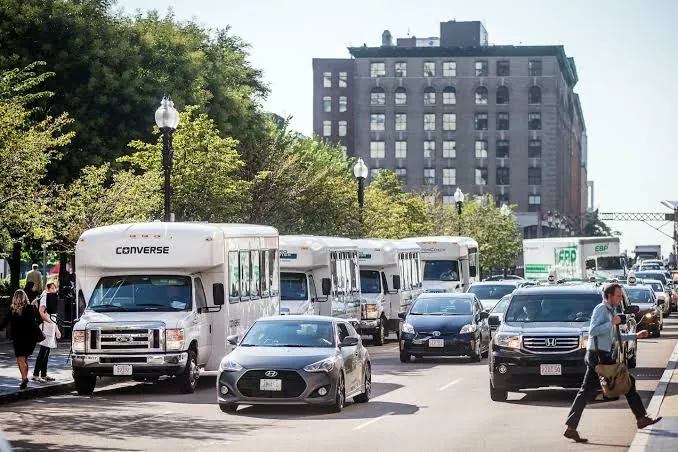
Corporate Shuttle Service in Boston: Connecting Kendall Square, the Seaport, and Logan Airport for Business Travel
Boston's business community spans several major commercial and innovation hubs. Companies in technology, biotechnology, finance, and professional services may have employees and visitors traveling between Kendall Square, the Seaport District, the Financial District, and Logan International Airport.
Managing these trips with individual rideshares, taxis, or rental cars can become difficult when transportation is needed every day or during major meetings. A dedicated corporate shuttle Boston service provides a more organized way to move employees and business travelers between offices, hotels, airports, and event venues.
🚌 Why Businesses Use Corporate Shuttle Services
Corporate transportation is often about more than getting from one address to another. Employees may need to arrive at an office at a specific time, while visiting executives may have meetings scheduled across several locations.
Businesses can gain more control of these movements with a scheduled shuttle. Companies can define their own routes and picking up times, which can be used by their employees for the daily work, for meetings, or for special events.
🗺️ Connecting Kendall Square and the Seaport
Kendall Square, Cambridge, is a prominent technology and life sciences district, and Boston's Seaport District is another significant office, hotel, events and business district. While the two locations are fairly close, actual travel time may vary according to traffic and time of day.
The predictable route of a Kendall Square shuttle may be an option for staff commuters between offices, hotels and meeting sites. Businesses can design alternative travel schedules during the least busy parts of the day to avoid having to have employees make alternative arrangements.
🔁 Building a Recurring Shuttle Program
A regular service that runs a shuttle service as per a fixed timetable, instead of charging extra for each one-off trip. A business may choose to set up morning and evening routes for picking employees up from their points and take them to the office and provide further service for some time during the day between the points.
The schedule can operate daily, on selected weekdays, or around specific business events. Passenger demand can also be reviewed regularly so the company can adjust vehicle size, route frequency, or operating hours when business requirements change.
📋 Planning Employee Shuttle Routes
The initial step in an employee shuttle Boston program should be to study employee travel patterns. The office manager can determine the destinations of work travel, where employees must go and when, and determine when employees are most in need.
Factors to consider are employee location, office addresses, work schedules, the number of passengers, the capacity of the vehicles, pickup locations, traffic, and frequency of services. The objective is to design convenient routes but with no unnecessary stops or detours.
🧬 Supporting Boston's Biotech and Life Sciences Corridor
People commute from one office to another, from one lab to another, from one campus to another, to hotel, and from hotel to meeting, as part of Boston's biotech and life sciences community. Some of these organizations may also run early morning or late evening times (before or after the standard office hours) or have unusual office hours.
An operating pattern for a dedicated shuttle program may be developed based on these patterns. For companies that are spread out across the biotech/life sciences corridor in Boston, scheduled transportation can also help to move employees from one facility to another, and avoid the need to arrange independent trips for employees.
✈️ Managing Logan Airport Executive Pickups
Logan International Airport (BOS) is a top destination for business visitors to Boston. Executives with busy schedules may require transportation to be arranged prior to their arrival, especially if a number of executives are arriving at the same time.
Flight information, hotel locations and meeting times can be used to set up airport pickups. Depending on the program, the executives can be taken directly to an office, hotel, conference center or any other business destination.
🏢 Connecting the Seaport and Financial District
The Seaport District and Financial District are key business destinations where employees and visitors routinely travel between their offices, hotels, restaurants, and meeting places. These trips can be managed independently, but when multiple persons are traveling at the same time, this is not an efficient way to run these trips.
A Seaport Shuttle Boston can be available between the main business areas in times of high traffic. It can also be utilized to help with conferences, corporate meetings, employee functions, and temporary transportation needs.
💵 Understanding Corporate Shuttle Costs
There is no standard price for corporate transportation because every program has different requirements. The final cost can depend on passenger numbers, vehicle type, route distance, number of stops, service frequency, operating hours, and airport or event requirements.
Cost Factor | What It Affects |
|---|---|
Passenger count | Required vehicle capacity |
Vehicle type | Overall operating cost |
Route distance | Travel time and mileage |
Service frequency | Number of daily trips |
Operating hours | Duration of the service |
Number of stops | Route length and travel time |
Airport transfers | Additional scheduling requirements |
Special events | Extra vehicles or customized schedules |
For recurring programs, companies should request a quote based on their actual routes and passenger demand. Comparing the cost with rideshares, parking, rental vehicles, or mileage reimbursement can provide a clearer picture of the overall value.
🚦 Making Daily Transportation More Predictable
The commuting times in Boston can be unpredictable, especially during rush hour. Therefore, to develop a corporate shuttle schedule, it is necessary to take into account realistic travel time allowances, not the fastest possible travel time.
Boarding may be more efficient, as well, if designated pickup points are used. Employees must be given clear instructions on where to pick up, when to come and get, route and what to do if they miss a departure.
📅 Supporting Business Events and Meetings
Corporate transportation is not limited to daily employee commuting. Companies may also need transportation for conferences, training programs, client meetings, office events, team activities, and executive visits.
A business shuttle service Boston program can be adapted for temporary requirements as well as recurring routes. For example, a company hosting a multi-day event can arrange transportation between selected hotels and the venue according to the event schedule.
🏙️ Connecting Multiple Business Locations
Companies with offices across Boston and Cambridge may need employees to travel between headquarters, satellite offices, laboratories, client sites, and meeting venues. Repeated individual trips can take time and create inconsistent arrival schedules.
A coordinated corporate transportation Boston plan can establish specific routes around recurring business needs. This gives companies a structured way to move employees between locations while allowing schedules to be built around meetings and operating hours.
🚐 Choosing the Right Vehicle
The right vehicle depends on passenger volume and the type of transportation required. Smaller groups may need a passenger van or shuttle vehicle, while larger employee populations may benefit from minibuses or full-size motor coaches.
Vehicle selection should also account for luggage during airport transfers and the level of comfort required for executive travel. For employee commuting, capacity and frequency may be more important than premium features.
🤝 Creating a Reliable Shuttle Network
The first step in a successful shuttle program for the corporation is to know the transportation needs. The travel coordinator is responsible for determining the routes and destinations of employees, hotel needs, airport arrivals, the number of passengers and peak travel times.
A transportation provider can use these data to assist in the decisions of vehicle type, pick-up locations, frequency and hours of service. The plan can then be reviewed from time to time depending on the changes in staff schedules, office locations and business needs.
🌟 A Smarter Approach to Business Travel in Boston
Moving employees and business visitors between Kendall Square, the Seaport District, Financial District, and Logan International Airport can become complicated without a coordinated plan. A corporate shuttle Boston service can simplify these movements through scheduled routes and designated pickup points.
Recurring employee routes, executive pickups at the airport, or transportation for a corporate event – it depends on the need of the passengers along with the scheduling, vehicle needs and route planning. With a thoughtful approach, a shuttle system can improve the predictability and convenience of business travel in Boston.